
 By Rob Petrosino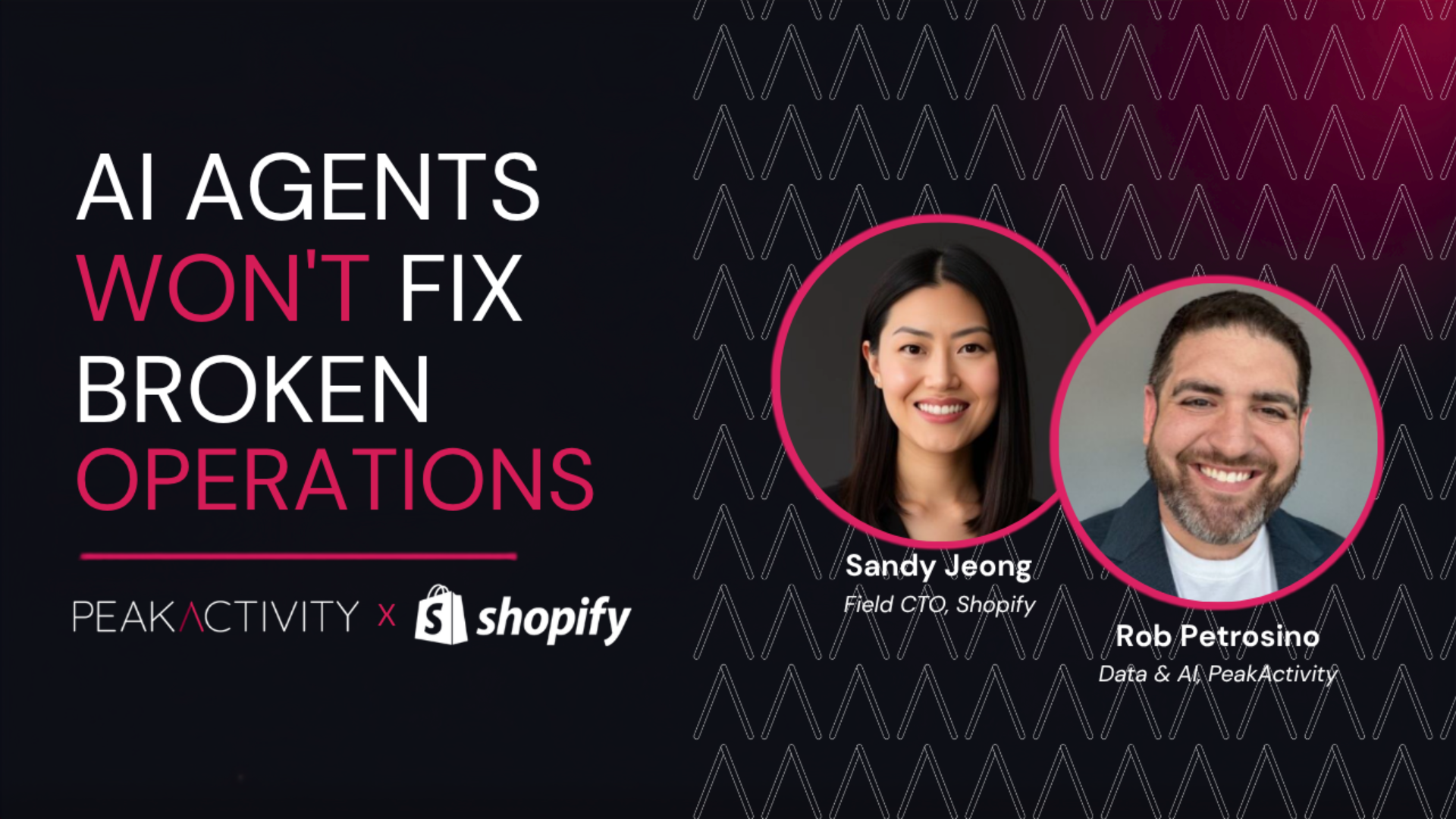
By Rob Petrosino, Chief Innovation Officer, PeakActivity | Featuring Sandy Jeong, Field CTO, Shopify
The most dangerous moment in enterprise AI adoption isn’t when the technology fails.
It’s when it works exactly as designed — inside an operation that was never ready for it.
That’s the conversation Sandy Jeong (Field CTO, Shopify) and I had in our latest fireside chat. Not the vendor-pitch version of AI agents. The operational one. What has to be true about your data, your workflows, and your decision rights before an agent can be trusted with any of them. Watch the full conversation, or keep reading for the parts we think matter most.
“It’s Like Flipping the Lights on in the Basement”
Enterprise leaders keep asking the wrong first question: Which AI platform should we buy?
The better question is: Where does our operation actually break down, and is that a data problem, a workflow problem, or a people problem?
Most of the anxiety around AI comes from not having answered that. As I said in the conversation:
“I always say it’s like flipping the lights on in the basement, right? When you’re a kid, everything’s very, very scary. But put some lights on, everything’s fine.”
That’s the whole exercise. Define the use case precisely enough, and the scariness mostly disappears — because you’re no longer deploying AI into the dark. You’re deploying it against a specific, bounded, well-lit problem.
Sandy’s read on where the fragmentation actually lives:
“All your data connected to different marketplaces and channels… it all needs to tie back to your OMS and your WMS. Do you add a DAM? It’s just all over the place.”
If your product, inventory, and customer data live across systems that don’t talk to each other, an agent sitting on top of that mess doesn’t fix it — it just executes the mess faster.
The Horseshoe Problem
There’s a specific adoption pattern we see across almost every retail organization, and it’s not the one people expect. It’s not “cautious vs. aggressive.” It’s both extremes failing for opposite reasons — what I called, in the conversation, the horseshoe effect:
“You have one side that’s just very hesitant and doesn’t know what to do. The other side that’s so fast-moving and so focused on making sure they’re doing something. They kind of are pinching together to the point where probably not getting the best experience and the best ROI.”
Frozen leadership and reckless leadership land in roughly the same place: wasted budget, no compounding advantage. The organizations getting this right are the ones in the middle — moving deliberately, on a defined use case, with a data foundation underneath it.
Two Use Cases Already Producing Real Numbers
We didn’t speculate about the future in this conversation. We talked about what’s working right now, in production, for actual retailers.
Agentic commerce. Consumers are researching products inside Gemini, ChatGPT, and Copilot before they ever land on a brand’s site. Sandy’s read on the early data from brands investing here:
Traffic through these AI surfaces is rapidly increasing, those sessions are converting at a much higher rate, and they carry a higher AOV than typical traffic.
The mechanism is straightforward: LLMs are currently crawling and scraping brand sites for product information. Brands that make sure their product data is structured and accurate for that crawl are showing up correctly in AI-driven research — and capturing purchase intent earlier than they used to.
AI-assisted selling on the floor. The associate opportunity isn’t replacing salespeople — it’s giving every associate the knowledge of your best one:
“Imagine scaling your best associate to every single associate using artificial intelligence.”
Concretely: aggregating customer questions, product data, and inventory in real time so an associate can make a strong recommendation on the spot, instead of losing the moment while they go look something up.
Both of these work for the same reason: bounded scope, underlying data that is clean enough to act on, and a clear metric for whether it is working.
Personas No Longer Apply
One line from the conversation is worth sitting with on its own, because it reframes what “personalization at scale” is actually starting to mean:
“Personas no longer apply in an AI world because every individual is a persona.”
That’s not a marketing line. It’s a description of what becomes technically possible once an agent can act on real-time context instead of a static customer segment. The organizations that treat this as a genuine shift, not just a faster version of the old segmentation model, are the ones that will actually feel the difference in conversion.
What 18 Months From Now Looks Like
Sandy’s point on model velocity is one enterprise leaders consistently underweight:
“If I build an agent today… that model is going to get switched out over time. It’s not going to use the same model today that it will in three months. That means you’re only going to get an AI agent that’s smarter in three months than you have today.”
That means the gap between organizations that started 12 months ago and organizations that have not started is not linear. It compounds. Every model upgrade makes the already-deployed agent better for free. Every quarter of delay is a quarter where that compounding didn’t happen.
Failure Is Data, Not a Verdict
The internal posture that makes any of this survivable, in Sandy’s words:
“Failure is just the successful discovery of a path that didn’t work.”
Which matters because the organizations getting real value out of AI right now aren’t the ones with a flawless track record. They’re the ones willing to run the experiment, capture what didn’t work as institutional knowledge, and keep moving — instead of treating the first failed pilot as a reason to freeze the whole initiative.
Watch the Full Conversation
This post covers maybe a third of what Rob and Sandy actually got into — including the specific risk of “bad at scale,” how customer experience changes when AI supports (rather than replaces) human judgment, and where Sandy thinks the next 18 months of retail AI adoption is actually headed.
Watch the full fireside chat →
Where does your operation actually stand when it comes to data, workflows, decision rights, and AI readiness?
We built a quick AI Ops Diagnostic for enterprise commerce leaders. Tell us your biggest operational AI challenge, and we’ll help identify where your data, workflows, and operational foundation may need attention before AI can scale effectively.
PeakActivity is a digital strategy and technology partner helping mid-to-large enterprises connect commerce, data, AI, automation, and operations to create better customer experiences and measurable business outcomes.